From everyday skin care
to clinical recovery
Because better circulation and oxygenation help almost everywhere skin needs support, carboxytherapy appears across many settings. These four are the most common.
Because better circulation and oxygenation help almost everywhere skin needs support, carboxytherapy appears across many settings. These four are the most common.
Ongoing support for tone, texture, hydration, and radiance.
Pre-treating the skin to prepare the environment for an aesthetic procedure or surgery
Calming skin after lasers, microneedling, and injectables.
Comfort and recovery support around surgical procedures.
Support for delicate tissue and intimate skin health.
After skin has been worked on by a laser, a needle, or a scalpel, it benefits from exactly what carboxytherapy encourages: more circulation, more oxygen, and support for the body’s own repair. Here’s how it’s used in four contexts.
Always follow the specific instructions of your own provider, who knows your treatment and your skin. The guidance below is general education, not a personal treatment plan.
You don’t need to be recovering from a procedure to benefit from better-oxygenated skin. Used as part of a routine, carboxytherapy targets the everyday markers of healthy skin: hydration, smoother texture, more even tone, and a brighter, lit-from-within look. Because it improves circulation rather than stripping or resurfacing, it tends to be gentle enough for regular use.
HOW IT’S TYPICALLY USED
Often used on a recurring basis, folded into an existing skincare routine. A single session is short and usually needs no downtime, which is why it’s popular as a “reset” before an event or as ongoing upkeep.
GOOD TO KNOW
Results are cumulative and gradual. This is upkeep, not a one-time transformation. Consistency matters more than intensity. Pair it with the fundamentals oxygen supports: hydration, sun protection, and a simple routine.
The same repair processes that run during recovery — cellular energy, collagen support, healthy circulation — all depend on oxygen. Building up that supply before surgery means tissue begins its recovery from a stronger starting point rather than playing catch-up.
HOW IT’S TYPICALLY USED
Carboxy therapy can be used as a short lead-up series in the weeks before a planned procedure, on a schedule your provider recommends based on the procedure and your skin.
GOOD TO KNOW
Any pre-surgical preparation must be coordinated with your surgeon. Share your full plan with them, and follow their guidance on what to do — and stop — before your procedure date.
Many popular treatments work by controlled injury. Lasers, microneedling, radiofrequency, and peels deliberately stress the skin so it rebuilds stronger. That leaves skin temporarily red, swollen, and busy repairing exactly when extra circulation and oxygen are most useful. Carboxytherapy is frequently used alongside these procedures to support recovery and calm the visible after-effects. With injectables, the interest is often in soothing the area and easing bruising and swelling.
HOW IT’S TYPICALLY USED
Providers may apply a topical treatment shortly after an in-office procedure, and some send patients home with a short course for the following days. Being needle-free and non-abrasive, the topical form suits skin that’s already been treated.
GOOD TO KNOW
Timing and suitability depend entirely on the specific procedure, some have particular aftercare windows. This is a “coordinate with your provider” situation.
You don’t need to be recovering from a procedure to benefit from better-oxygenated skin. Used as part of a routine, carboxytherapy targets the everyday markers of healthy skin: hydration, smoother texture, more even tone, and a brighter, lit-from-within look. Because it improves circulation rather than stripping or resurfacing, it tends to be gentle enough for regular use.
HOW IT’S TYPICALLY USED
Used strictly as directed by the surgical team, sometimes beginning in the clinical setting and continuing at home over a defined recovery period. It is a supportive adjunct to a surgical plan, never a replacement for one.
Medical supervision required. Post-surgical care must always be directed by your surgeon. Don’t add any treatment including this one to your recovery without their explicit guidance. Incisions, timelines, and individual risk factors vary enormously.
The same circulation-and-oxygen logic applies to the delicate skin and tissue of intimate areas. Interest here centers on supporting tissue comfort, hydration, and resilience needs that commonly arise with hormonal changes, after childbirth, or over time. Because the topical approach is gentle, it has become a discreet option in this category.
HOW IT’S TYPICALLY USED
Typically a topical treatment designed for delicate tissue, used on a schedule appropriate to individual needs. As always, a qualified provider should guide whether it’s appropriate for you.
GOOD TO KNOW
This is where personalized, professional guidance matters most. Concerns about intimate or hormonal health deserve a real conversation with a qualified clinician.
Because better circulation and oxygenation help almost everywhere skin needs support, carboxytherapy appears across many settings. These four are the most common.
Ongoing support for tone, texture, hydration, and radiance.
Pre-treating the skin to prepare the environment for an aesthetic procedure or surgery
Calming skin after lasers, microneedling, and injectables.
Comfort and recovery support around surgical procedures.
Support for delicate tissue and intimate skin health.
After skin has been worked on by a laser, a needle, or a scalpel, it benefits from exactly what carboxytherapy encourages: more circulation, more oxygen, and support for the body’s own repair. Here’s how it’s used in four contexts.
Always follow the specific instructions of your own provider, who knows your treatment and your skin. The guidance below is general education, not a personal treatment plan.
You don’t need to be recovering from a procedure to benefit from better-oxygenated skin. Used as part of a routine, carboxytherapy targets the everyday markers of healthy skin: hydration, smoother texture, more even tone, and a brighter, lit-from-within look. Because it improves circulation rather than stripping or resurfacing, it tends to be gentle enough for regular use.
HOW IT’S TYPICALLY USED
Often used on a recurring basis, folded into an existing skincare routine. A single session is short and usually needs no downtime, which is why it’s popular as a “reset” before an event or as ongoing upkeep.
GOOD TO KNOW
Results are cumulative and gradual. This is upkeep, not a one-time transformation. Consistency matters more than intensity. Pair it with the fundamentals oxygen supports: hydration, sun protection, and a simple routine.
The same repair processes that run during recovery — cellular energy, collagen support, healthy circulation — all depend on oxygen. Building up that supply before surgery means tissue begins its recovery from a stronger starting point rather than playing catch-up.
HOW IT’S TYPICALLY USED
Carboxy therapy can be used as a short lead-up series in the weeks before a planned procedure, on a schedule your provider recommends based on the procedure and your skin.
GOOD TO KNOW
Any pre-surgical preparation must be coordinated with your surgeon. Share your full plan with them, and follow their guidance on what to do — and stop — before your procedure date.
Many popular treatments work by controlled injury. Lasers, microneedling, radiofrequency, and peels deliberately stress the skin so it rebuilds stronger. That leaves skin temporarily red, swollen, and busy repairing exactly when extra circulation and oxygen are most useful. Carboxytherapy is frequently used alongside these procedures to support recovery and calm the visible after-effects. With injectables, the interest is often in soothing the area and easing bruising and swelling.
HOW IT’S TYPICALLY USED
Providers may apply a topical treatment shortly after an in-office procedure, and some send patients home with a short course for the following days. Being needle-free and non-abrasive, the topical form suits skin that’s already been treated.
GOOD TO KNOW
Timing and suitability depend entirely on the specific procedure, some have particular aftercare windows. This is a “coordinate with your provider” situation.
You don’t need to be recovering from a procedure to benefit from better-oxygenated skin. Used as part of a routine, carboxytherapy targets the everyday markers of healthy skin: hydration, smoother texture, more even tone, and a brighter, lit-from-within look. Because it improves circulation rather than stripping or resurfacing, it tends to be gentle enough for regular use.
HOW IT’S TYPICALLY USED
Used strictly as directed by the surgical team, sometimes beginning in the clinical setting and continuing at home over a defined recovery period. It is a supportive adjunct to a surgical plan, never a replacement for one.
Medical supervision required. Post-surgical care must always be directed by your surgeon. Don’t add any treatment including this one to your recovery without their explicit guidance. Incisions, timelines, and individual risk factors vary enormously.
The same circulation-and-oxygen logic applies to the delicate skin and tissue of intimate areas. Interest here centers on supporting tissue comfort, hydration, and resilience needs that commonly arise with hormonal changes, after childbirth, or over time. Because the topical approach is gentle, it has become a discreet option in this category.
HOW IT’S TYPICALLY USED
Typically a topical treatment designed for delicate tissue, used on a schedule appropriate to individual needs. As always, a qualified provider should guide whether it’s appropriate for you.
GOOD TO KNOW
This is where personalized, professional guidance matters most. Concerns about intimate or hormonal health deserve a real conversation with a qualified clinician.
Every provider and treatment differs, but here’s what a topical carboxytherapy experience tends to involve.
Most describe it as comfortable, often cool and tingling as circulation increases. Generally not painful.
Sessions are typically short, on the order of under an hour.
Non-invasive topical methods usually involve little to no downtime. Injectable methods may differ.
A fresh, hydrated, plumped look can appear quickly; overall skin-quality changes build gradually.
Because benefits are cumulative, a series of sessions is common rather than a single treatment.
Your provider tailors the method and schedule to your skin and goals.
The applications described in this guide are available as medical-grade carboxytherapy gels for at-home use. These are the two treatments we recommend.

For face & body
Non-invasive, needle-free carboxytherapy gel for face, eyes, neck, and body — standalone or as post-procedure care after peels, lasers, microneedling, injectables, or surgery.
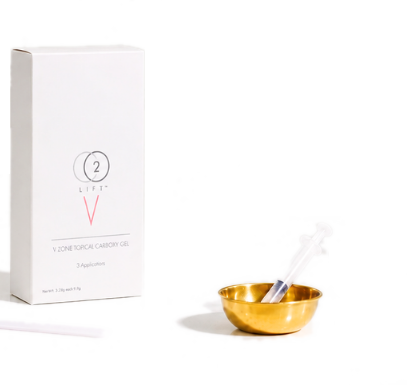
For intimate wellness
Hormone-free, pain-free gel for delicate vulvar and vaginal tissue, supporting hydration, comfort, and elasticity through aging, childbirth, or hormonal changes.